Showing posts with label tips. Show all posts

6 August 2014

What's hot in Seville

An article by actor/travel writer Andrew McCarthy for Travel + Leisure magazine provides a few tips on what's hot in Seville, or well, on what worked for him, at least. Andrew fills you in about the daily rhythm of life in Seville, street living, people worshipping statues of weeping virgins, late lunches followed by afternoon siestas, late-night tapas crawls, old-school waiters with their legendary chalk-scribbled bills on the wooden bars right in front of the customers, and he also, of course, tells you about flamenco and bullfights.

Seville at night. Photo by Christopher Testani

Read the full article by Travel and Leisure here.

26 July 2014

How Sevillians do tapas

Want to discover what and how Sevillians eat? Kate Thomas, a travel filmmaker and journalist shows you the way. Go check out her article at the Huffington Post about how they do tapas in Seville here and then head to her YouTube Channel Travel With Kate for more!

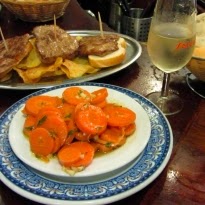
Delicious tapas in Triana. Image from Kate's tips site


2 August 2013

Wiping out the roaches. Iberian wall lizard

There is still hope for cockroach despisers. Iberian wall lizard (la lagartija) can defeat these seemingly invincible beasts that invade your apartment with relative ease, ready to make a meal out of them. They may also be a nuisance, no argument here, but there are two ends of every rainbow, however.

Small lizard eating an insect entered its host's (so to say) place. Photo by Paul Pen

How could one possibly smash a small lizard with a boot knowing that it may be almost the only being willing to take care of the disgusting up to 7,5 cm long roaches that have put such hurt on man? I couldn't, sure thing. I prefer the lagartijas any time over any other animals interested in the roaches; be that invertebrates, reptiles or mammals. 

Small lizard eating a cockroach. Photo by HolzCL

I admire them for the way they are. For their skittery yet graceful presence on the streets and walls of the cities and villages in Andalusia, for serving a temporary decoration on white paint and for putting life into breathless heat-beaten late afternoon wanderers, anxious to smash them, though.

Lizard street art in Málaga. Photo by Carlos Pérez Torres; see more on www.ymalaga.com

Here's a book recommendation for those who read Spanish: “El Baile de las Lagartijas”, a 2011 novel by David de Juan Marcos, a young Salamancan writer, graduated in Biology.

26 June 2013

Magic and music

There are places in Seville you can go twice a week at night for a free magician show, such as a legendary pub in Los Remedios neighbourhood called Magic and Music (Magia y Música), active since 1989, where the local people who practise magic perform on Fridays and Saturdays. Often it's Mario el Mago, but it can also be another practising member of the Association of Magicians of Seville (Asociación de Magos de Sevilla). They have 50 years of history to draw on that involves a lot of enthusiasm and peer learning – the guys come together every week and experiment and rehearse for not getting rusty.
Mario el Mago. Photo taken from Mario's website

23 May 2013

In the search for spirits. Vodkas, rums and gins

I overheard three Finnish guys talking on the bus the other day that made me ask to myself: how do they, poor things, survive down here? I'm not saying that it seems impossible, but I admit, it must be challenging. To be literally not able to buy vodka for having no choice whatsoever, well, for having no more than three labels to choose from. Which is as good as nothing. Especially considering that one of them is not known in the part of the world these guys are from.

A common sight in the supermarkets

About the choices. One of the brands in the market - Absolut Vodka - is Swedish. It is extraordinary and should be ranked among the best vodkas in the world. I suggest you not to trust any top 10 or whatever lists that don't have Absolut Vodka in it. Seriously!

Then there is Smirnoff Vodka that, though originally Russian, belongs to a British Company. It has gone hand in hand with James Bond for more than 50 years. Somehow this doesn't sound sexy to me. At all. It makes me sort of critical about its glamorous comercial image instead. Off it goes! ¡Fuera! Just joking, it's an honest drink...

And, the third - Vodka Knebep - doesn't really count. It's a brand of a Spanish supermarket chain, Mercadona, but yet, let's be honest, Spain ain't no vodka producer!

The Finns living here, on the other hand, are from a colder climate originally and therefore used to strong spirits with pure and simple taste. Being from the Northern Europe myself, I'm somewhat familiar with their needs and likes. I would also have a shot of straight, freezing-cold Swedish, Finnish or Estonian vodka every now and then, although I'm one hell of a good cocktail maker. In any case, my personal top would be as depicted in the following picture.

My favourite vodkas

Viru Valge is the best Estonian vodka. For me, a couple of quality brands of Estonia are the purest and best-tasting vodkas in the world, the second-best being Saaremaa Vodka. It also applies to their flavoured products. These are a definite must-try!

Viru Valge flavoured vodkas

Saaremaa Vodka, pure and rhubarb-flavoured

Findlandia Vodka is the best Finland has to offer. And man, they have used pure glacier water to produce it: what more proof you need than this?

So, what to do about it in Spain? Nothing but have rum (ron) or gin (ginebra). A news site abcdesevilla.es has published a top 10 list of essential rums to help you out in the wide choice you might be confronted with, but thanks to my friends I also know a thing or two.

Of the Dominican rums available in Spain, Barceló and Brugal are the two brands worth trying, and Matusalem too, however it has Cuban origins.

Ron Barceló

Ron Brugal

Ron Matusalem

Of Guatemalan rums, Zacapa is your best choice, and of Venezuelan ones, Santa Teresa.

Ron Zacapa

Ron Santa Teresa

And finally, as it would be still nice to have something strong from Europe on the table, let it be a bottle of G'Vine gin from France.

G'Vine gins

22 April 2013

Understanding the Sevillanas through examples

Today, I also want to bring to your attention the Sevillanas usually heard and played at the Seville Fair, especially in the stands (casetas) where live music is not performed. First, I want to share with you a list of the top 10 Sevillanas that made history drawn up by M. Moguer, which I found on the news site ABCdesevilla. Based on this list the most typical ones are the following: Mirala cara a caraCántameEsta niña viene tarde¡Ay que te como!Sevillanas de los bloquesCuando un amigo se vaSueña la MargaritaHistoria de una amapolaMe casé con un enano; and, A bailar sevillanas.

Here are some more examples for you to enjoy:
:


11 April 2013

Wines the Andalusians love

It has as much to do with agriculture as it has to do with culture. It involves people, both vine growers and wine makers. It's all tied together. Spain, and Andalusia in particular, is a hotbed of both agriculture and culture. When the two come together, an abundance of unique senses of well-being obviously arise.
Enologist from Jerez (Image of Regulation Council of Sherry Wines)

Grapes are the third biggest crop in Spain after cereals and olives. Spain is the number one ranked country in the world in terms of area covered by vineyards (superficie de viñedo), but as the climate is dry, it is only third wine producer (productor vitícola) behind France and Italy, according to the data released by the International Organisation of Vine and Wine (see the references). One third of Spanish wine is exported. Although most of wine made in Spain is red, more than 60% of its vineyards are white. This is because Spain also produces a lot of brandy and sherry. The main red grape varieties in Spain are Tempranillo, Bobal, Garnacha (Grenache) and Monastrell, the white grape ones being Airén, Macabeo, Palomino and Pedro Ximenez. There's one more curious fact that you merely may possibly not be aware of, although not relevant to the issue at hand: Spain is one of the top five importers of Scotch whiskey in the world.
Harvest of Palomino grapes at Barbadillo's vineyard (Image from news site Globedia)

In Andalusia, the focus is on high quality production - more than 70% of the vineyards are located within the boundaries of one of the following six Denominations of Origin and run under that designation: Condado de Huelva, Jerez-Xérès-Sherry (also produced in one municipality of Seville), Málaga, Manzanilla de Sanlúcar, Montilla-Moriles, and Sierras de Málaga.

Jerez-Xérès-Sherry D.O. label

There are also 16 wines with geographic designation (Vinos de la Tierra label) in Andalusia with a level of quality certification which lies somewhere between that of common table wines and Denomination of Origin status. They are of medium quality and good value for money.

Geographic designation label for the wines from Cádiz

The sherries from Jerez are startlingly delightful, the dry as well as the sweet, raisiny versions. This explains that if you asked the Andalusians to name the wines they love most, it would go something like this: “If you are thinking of red wines, I would suggest Rioja and Riberia del Duero. In terms of white wines, I would stick to those from Jerez.” One of their top reds would probably be Rioja, the other may vary from person to person. But see, still all from Spain!

A glass of dry sherry (Image from a blog)

People outside of Spain, by and large, do not drink sherry, and tend to regard it as a dessert wine. In Andalusia, sherries are appreciated dry, so, you should try to taste some of the dry ones. Manzanillas and Finos, the lighter, dry sherries make exquisite aperitifs, perfect for sipping a little at a time and enjoying with green olives.

Fresh olives

Have a small glass (copita) of cold Solear Manzanilla (Bodegas Barbadillo, D.O. Jerez-Xéres-Sherry), for example.
NV Barbadillo Jerez-Xérès-Sherry Manzanilla Solear

For more, go to the guide of the best wines from Spain by José Peñin.

However, I have one more point to make. The Andalusians do not have blinders on, being open to all there is to taste in the world-wide wine market. They also treasure the sensations brought about by foreign beverages. A wine, for instance, a friend of mine loves, is Tokaji Oremus from Hungary.

2000 Oremus Tokaji Szamorodni Édes Sweet

29 March 2013

Best time to visit Seville

The best time to come to Seville obviously depends on what kind of person are you. Every season has its distinct charm and appeal, however. In general, the best time to visit Seville is during spring and autumn as the temperatures are nice: it's warm enough - but not too hot - for eating in the open air and being comfortable.

It would be especially wise to take off on your trip in spring when the orange blossom is out and do that better in March, right after torrential February rainstorms. Note, that orange flower buds form in early winter and bloom in late winter and in spring. The orange blossom is a really showy flower and the smells of the city at that time are as sweet as it sounds. On top of that, Seville is known for its pompous public celebrations and now (in late March/April) is exactly when the Holy Week (Semana Santa) celebrations are on. So, it's a good time to be here and take part in the festivities. And, without a doubt, to stick around for the April Fair (Feria de Abril), immediately after Easter.

About the legendary Seville oranges. They are not edible raw. You could pick them, of course, the streets are hemmed in by orange trees for real, but they are good for nothing but pleasing the eye and nose.
Seville at orange flower bloom time

If you're coming to see the sights or visit friends and/or family, September and October are the best time to be in Seville. This is when we here have no distractions and may wander with you around the city, take photos of countless beauties (everything that reflects local customs, I mean) and have a wonderful time sitting outside to eat.


Typical morning moments of eating out

For lovers of Flamenco there is a wonderful international festival every two years, the Bienal de Flamenco, which takes place in September (next in 2014, for the 18th time already).

28 March 2013

Places to eat

Despite the fact that I personally have some trouble eating out in Seville because of the kitchen opening hours of cafés, bars, pubs, taverns and restaurants which do not always coincide with the time I feel hungry, I would like to suggest you a few places to eat around here. And these are some of the places me and my friends love the most.
  • Tavern “Los Coloniales”, my absolute favourite, near Plaza de la Encarnación that is known for a modern piece of architecture the Metropol Parasol
Image taken from the web site of an association of people
interested in jazz, wine, literature and good eating
  • Restaurant “Kaori” at the Gran Casino Aljarafe of Seville in Tomares (another metropolitan municipality) offering the best Japanese food in the metropolitan area of Seville
  • Restaurant “Los Jarales” at the Shopping Centre Aljarafe in Camas (another metropolitan municipality) offering authentic Mexican food
  • First-class Italian restaurant “Il Basilico” in Mairena del Aljarafe
  • Tapas bar “Las Columnas” in the old town (Santa Cruz neighbourhood) of Seville, near the Church of El Salvador
  • Small bar “Blanco Cerrillo” with its speciality “Adobo” also in the old town, near the street Tetuán
  • Restaurant “El Cenachero” in Sevilla Norte for more special ocasions since its a bit pricey

17 February 2013

Sites worth to visit in Seville

Below are the some of the favourite cultural attractions of Seville as recommended by travellers from all over the world according to TripAdvisor, World's Best Places, Lonely Planet and Sacred Destinations:


  • Reales Alcázares de Sevilla (Royal Alcazars of Seville) - the oldest royal palace still in use in Europe;
  • Plaza de España (Spain Square) - a plaza built for the Ibero-American Expo of 1929;
  • Barrio Santa Cruz (Santa Cruz Neighbourhood) - the former Jewish quarter of the medieval Seville;
  • La Giralda (The Giralda) - a former minaret that was converted to a bell tower for the Cathedral of Seville;
  • Casa de la Memoria de Al-Andalus (Memorial for Andalusí Culture) - Flamenco club;
  • Catedral de Santa María de la Sede (Cathedral of Seville) - a Roman Catholic cathedral, being the largest Gothic cathedral and the fourth-largest church in the world;
  • Parque de María Luisa (The Maria Luisa Park) - a public park that stretches along the Guadalquivir River;
  • Museo de Bellas Artes de Sevilla (Museum of Fine Arts of Seville) - one of the greatest collections of mainly Spanish visual arts from the medieval period to the early 20th century;
  • Plaza de Toros de la Real Maestranza de Caballería de Sevilla (The Bullring of Seville) - the oldest bullring in Spain;
  • Casa de Pilatos (Pilate's House) - a prototypical Andalusian palace, which serves as the permanent residence of the Dukes of Medinaceli;
  • Iglesia Colegial del Salvador (Collegiate Church El Salvador) - the Seville's second biggest Roman Catholic religious temple;
  • Torre del Oro (The Gold Tower) - a twelve-sided military watchtower, built in order to control access to Seville via the Guadalquivir river;
  • Real Fábrica de Tabacos (The Royal Tobacco Factory) - an 18th-century stone building, which was a lineal descendant of Europe's first tobacco factory and currently serves as the seat of the rectorate of the University of Seville;
  • Basílica de Santa María de la Esperanza Macarena (The Basilica of Macarena) - seat of a Holy Week brotherhood Hermandad de la Esperanza Macarena, possessing the most revered image in Seville, Nuestra Señora de la Esperanza (Our Lady Hope), which Sevillians call La Macarena;
  • Casa de la Guitarra (The Guitar House) - a museum and venue for flamenco shows.