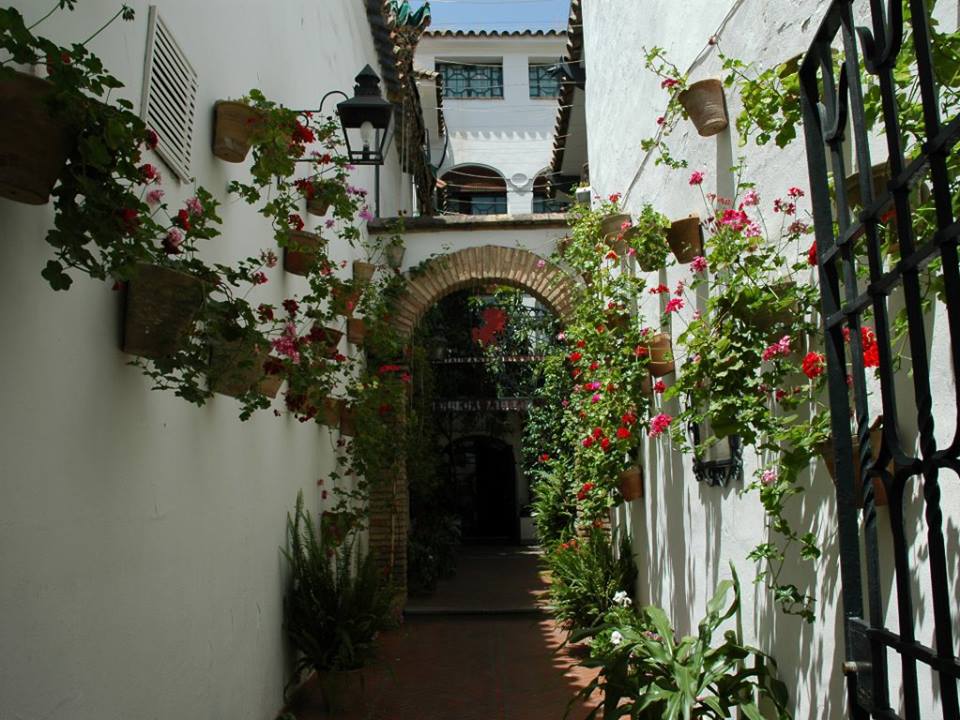
El Perro Andaluz (The Andalusian Dog) is a cultural café-bar, a fun place to go. I have been there
twice. On both occasions I went there with the same friend, and I'm thankful to him for taking me to such a dreamy place for a night. I hadn't
had time to expect too much, because both times it was a spontaneous
decision to go there. And seriously, I had no idea what sort of music
they put out, which is always a kind of sensitive issue for people
like me who are really into music, but only certain types of music.
In the end, it turned out that I liked the vibe of the place from the
minute I walked in and I will definitely go back there again and
again, and again. And you know why? Because it brought me in my mind to the night life fun in my beloved Tartu, one of the coolest university towns in Europe, a town of cosy cafés, awesome bars and amazing people.
Interior of El Perro Andaluz. Image
from their Google+ profile
Anyway, back to the topic at hand, the bar in Seville. I
first got amazed with with it listening to a reggae fusion music project
that mixes various styles, such as reggae, ska and rumba, called La
Dstyleria. It was so unspeakably cool that I couldn't quite believe
they were real and I literally fell in love with all the guys on stage. For
more, see their Facebook or Twitter page.
Have a look at and listen to the band in action:
There
is always a new art exhibition on display in El Perro Andaluz that is worth checking out, and there are always some bands playing for
free or poetry reciting or something else going on. Staff is friendly and the beer is
cold as hell (well, as ice), and the service is decent, too. Visit
their Facebook or Twitter page to be updated on upcoming events.
This time it's about Manuel Machado, a Sevillian-born poet of the Generation of '98, who I have paid too little attention to until now. I have only casually mentioned here on my blog that he was brother of Antonio Machado. The two of them so similar and yet so different. It's
widely known, as Juan C. Toledano, Associate Professor of Hispanic
Studies of Lewis & Clark College of Arts and Sciences, claims
(see the references), that Manuel Machado didn't share the Christian
socialist stance of his younger brother, Antonio Machado. It only
shows us that they were independent thinkers. They both had their own
truth that made them work for the greater good of the people they
cared for, their people. They may not have had the same exact
concerns, but what they surely had in common was love and caring for
Andalusia, and that is way more significant than it looks.
Manuel Machado y Ruiz (1874-1947). Image taken from a blog
In the play
written together, La Lola se va a los puertos (already described on several occasions earlier), the Machado brothers
do not display an Andalusia that is something mystical and far from
what its people lived in the streets in the 1920s, it's the Andalusians' Andalusia they expose. Naturally, this
is also where they differ from the other members of the Generation of
'98 who were no flamenco enthusiasts. The
Machado brothers disregard the non-Andalusian
way of life without almost
profane passion
for music, and
through the characterisation of La Lola they show how they view folk
art as essential and
constitutive:
Una
relación flamenca
de
hombre y de mujer, que no es
un
matrimonio cualquiera
entre
cristiano y cristiana
sino
algo más.
A
relationship of a man and a woman
in
flamenco is not like
any
marriage
between
Christians,
it's
more than that.
In
their play, it's flamenco that dominates them all being the
essence of the region, because
flamenco "noesmúsica,sinolenguadelcorazón"
(is
not music but the
language of
heart). Flamenco
is its
art and
its
heritage. And out of them two, it's especially Manuel's thing. Edward
F. Stanton, an overseas Cante Jondo expert, insists in his article (see
the references) that
Manuel wrote texts for Gypsy songs, while Antonio was
“smarter” for not wasting his creative energy on folklore; nevertheless, quite a few of Antonio's poems have also ended up in the
repertoire of flamenco singers. At
the same time, according to Francisco Gutiérrez Carbajo's study on Soleares (see
the references), Manuel gave a new life to a handful of old folk
songs.
Handwriting sample of Manuel Machado. Images taken from here
Manuel
Machado not only tried to incorporate this familiar and dear world to
him into poetry, but also published a book on Gypsy song in 1912 that he
titled “Cante Hondo”, which was the apparent precursor to the
García Lorca's book.
Among other things, Manuel
wrote a poem in honour of the provincial capitals of Andalusia, but
Seville, he thought, spoke for itself.
CANTO
A ANDALUCÍA
SONG
TO ANDALUSIA
Cádiz,
salada claridad. Granada,
agua
oculta que llora.
Romana
y mora, Córdoba callada.
Málaga
cantaora.
Almería,
dorada.
Plateado,
Jaén. Huelva, la orilla
de
las tres carabelas.
Y
Sevilla.
Cádiz,
salt-laden brilliance,
Granada,
hidden waters that weep.
Roman
and Moorish, silent Córdoba,
Málaga,
flamenco singer,
Almería,
golden.
Jaén,
silvery.
Huelva,
shore of the three caravels.
and
Sevilla.
Translation
taken from Elizabeth Nash's book (see the references)
To him the essence of Seville - his birthplace - was beyond words. This is just what James A. Michener, a Pulitzer-winning American author, says in his book "Iberia" (see the references):
“I was familiar with the rest of Spain before I saw Seville, but nothing I had learned elsewhere taught me so much about Spanish behaviour. Others have reported a similar experience for Seville does not have ambiente, Seville is ambiente, and nowhere has this been better expressed than in a lyric written by Manuel Machado, written in this century, which is quoted constantly throughout Spain. It is a litany of Andalusian names, each described with its most typical appositives, except one, for which no nouns or adjectives suffice.”
Here, listen to the interpretation
of Manuel Machado's Canto a Andalucía
by El Lebrijano. It's extraordinary!
In
her film,
La Lola se va a los puertos (1993),
the
director Josefina Molina crafts the story of a beloved flamenco
singer (cantaora) by airing
the
nationalistic vibes of
the era and letting the main character, acted
by Rocío
Jurado,
sing
La Bandera Blanca y Verde
(The White
and Green
Flag), the
official anthem of Andalusia, despite
the fact the
Machado brothers' play on which the film is based was published four
years before the andalucistas
came up with the idea that there were a song to sing of loyalty to
the region.
The
fervently
nationalistic lyrics
(Stand up! Demand land and freedom!)
of
the anthem were written by Blas Infante and the music for it
was composed by José del Castillo Díaz (Maestro
Castillo) in
1933.
The
melody, though Castillo's original, was inspired by the Santo Dios, a
religious chant
widely spread in rural Andalusia, usually sung by peasants and
day laborers
while harvesting
or finishing up their daily cutting.
Blas
Infante,
founder
of modern Andalusian nationalism,
in
his rebel youth. Image taken from a blog
The composition was adapted by Manuel Castillo in the 1980s. Since then, many cover versions have been performed by a large number and broad range of artists - by the people from Almería (almerienses), Cádiz (caditanos), Huelva (onubenses), Jaén (jienenses), Jerez de la Frontera (jerezanos), Málaga (malagueños) and by Cordovans (cordobeses) and Sevillians (sevillanos) - all proud of Andalusia. Below you have a selection of the versions of anthem, sung and played by the singers and musicians from all over the region.
Film version of the Himno
de Andalucía performed by Rocío
Jurado:
First-ever recording of
the Himno de Andalucía adapted by Carlos Cano and performed
by his musicians together with some members of the Juan Calabuig's
choir (Coral Heliópolis) in 1977, at the time the anthem was
practically unknown:
Rock version of the Himno
de Andalucía performed by Arábiga
at the Hijos del Agobio Festival in 2009:
Unfortunately,
there are no punk, rap or reggae versions of the anthem available. Not just yet, though. But there is a considerable range of flamenco versions that differ one from another depending on the musical features of the palo (style), of which Bulerías
and Tangos (de Granada) are, according to Walter Starkie (see the
references), Gypsy songs; and Tarantas, Alegrías,
Fandangos and Verdiales, Andalusian folk songs; as well as Rumbas,
as stated on an expert blog.
Himno de Andalucía por
Fandangos performed by (probably, for I don't know for sure) Arcángel (cantaor) and Niño Miguel (tocaor) (see the videoclip made up of photos of Andalusian views), and alternatively by Álvaro
Díaz:
Himno de Andalucía
por Verdiales performed in the street by malagueños and filmed by Mano Verde
movement:
Himno
de
Andalucía
por Rumbas
performed on TV by the
people
from Beas (Huelva) on their trip to Venezuela at 40 degrees Celsius
in the shadow and at incredible tropical humidity levels:
Andalusian people have always been awed about the magnificent river of Guadalquivir among the other manifestations of nature and many poets in these lands have also been inspired by those same waters. A Cordovan poetess, Concha Lagos (1909-2007) has written the lines I love most using a language so simple, crisp and plain, yet so deep and bottomless. Here you go.
Al
Guadalquivir
To
Guadalquivir
¡Qué
pequeño naces!,
niño,
río, amor,
¡Qué
grande te haces!
Born so wee,
boy, river, love,
you
grow so big!
Concha
Lagos with Vicente Aleixandre and other poets. Image taken from I.E.S. Carbula website
Note that this piece is very much in line with how the common people feel about their beloved river, the one that wines and dines and comforts them. You can read the same spirit in the work of Sevillian playwrights, Quintero brothers (Serafín, 1871-1938; Joaquín, 1873-1944). Here are extracts from a poem by the two, as it's
set in stone near a bridge (namely, Puente de las Herrerías) in the sources of the Guadalquivir
River.
See, a river in these dry, heat-beaten lands is pretty much an Alpha and Omega, the first and last, for it gives if honoured and protected and carries the dreams of many thousands good and honest Andalusians. Now, a poem by Antonio Machado that sums
it all up for me; let it touch you, too!
LXXXVII
LXXXVII
¡Oh
Guadalquivir! Te vi en Cazorla nacer;
hoy,
en Sanlúcar morir.
Un
borbollón de agua clara,
debajo
de un pino verde,
eras
tú, ¡qué bien sonabas!
Como
yo, cerca del mar,
río
de barro salobre,
¿sueñas con tu
manantial?
Oh
Guadalquivir!
I
saw you born in Gazorla
and
dying today in Sanlúcar!
You
were clear water bubbling
beneath
a green pine.
What
a fine sound you made!
Like
me, as you near the sea,
river
of brackish mud,
do you dream of
your springs?
Translated by
Alan S Trueblood (see the references)
My plan is to enjoy the next Seville Fair to the fullest, but I have a slight problem - I can't dance Sevillanas. I'd like to join the people dancing in the stands and streets. I'm not sure about the dress yet (whether or not to use an authentic, though modern one), but I want to go for longer hair and smoother dance moves.
Sevillanas
is an Andalusian folk dance made up of a series coplas(verses),
each one with a different choreography, the first of them being
considered the easiest. Each of the four coplas the Sevillanas
consists of are
split up into three sections (partes) and last
approximately 1 minute to 90 seconds depending on the tempo, making
the entire dance 4-6 minutes long. The music and cante
(song)
can
vary in each copla,
but there is a traditional structure that remains the same for all
four coplas.
This
dance is
never improvised, however, Sevillians tend
to
vary the choreography of it. Luckily, its
unique and clear structure allows dancers who have learned different
styles to perform Sevillanas together.
For me, the starting point to get the "ball rolling" and make the learning more effective is to visualise its composition. Here you have a scheme from a study assist website (sorry about not translating this).
The structure detailed as follows applies to whatever versions of
Sevillanas. For starters, before the actual dance steps there is an entrance
(salida) and cante introduction followed by an opening
pose (or vuelta normal). The first section of each copla includes standardized steps and choreography, particularly pasos
sevillanas and is followed by the first pasada that
consists of a series of short steps in which the dancers pass each
other, front to front or back to back, switching places as they do
so. In traditional versions of the dance, the pasada always
ends with one paso sevillana. The second section
has different steps than the first one, but lasts the same number of
beats, followed by the second pasada. The third
section differs from the first two and ends with the cierre,
which can include a final turn or a closing dance gesture that is a
highly stylized and personalized series of steps ending with the bien
parado - a traditional pose.
Watch
out some videos on YouTube to learn:
If
you find the videos provided very confusing and not helpful, below
is an explanatory table (by
Marisa) showing
the steps in each copla
(named, respectively, in Spanish: Primera
Sevillana,
Segunda
Sevillana,
Tercera
Sevillana,
Cuarta
Sevillana). Hope it does the trick!
FIRST COPLA
1st
section
2nd
section
3rd
section
5
sevillana steps
1
pasada
1
sevillana steps
4
esquinas
1
pasada
1
sevillana step
4
pasadas
1
vuelta (left)
SECOND COPLA
1st
section
2nd
section
3rd
section
1
sevillana step
3
rond de jambe
1
vuelta (left
1
pasada
1
sevillana step
6
pas de basque
1
vuelta (left)
1
pasada
1
sevillana step
8
pas de basque (circle)
vuelta
THIRD COPLA
1st
section
2nd
section
3rd
section
1
sevillana step
1
vuelta (left) + mark
1
vuelta (right) + mark
1
pasada
1
sevillana step
3
zapateados
1
vuelta (left)
1
pasada
1
sevillana step
1
pasada + mark
1
pasada + mark
1
vuelta (left)
FOURTH COPLA
1st
section
2nd
section
3rd
section
1
sevillana step
1
double spin (left)
1
sevillana step
1
double spin (right)
1
sevillana step
1
pasada
1
sevillana step + double stamp
1
careo
2
pas de basque
1
careo
1
vuelta (left)
1
pasada
1
sevillana step + double stamp
4
careos
1
vuelta (left)
Dance terms that can be read from the table are commonly undestood with the meanings given hereunder:
Careo - type of passing step used in the fourth copla only
Esquina (corner) - side to side step
Pasada - passing step, changing place with your partner twice in each copla
Sevillana - basic dance step performed in Sevillanas that includes a front and backward stepping pattern
Vuelta - regular (i.e. vuelta normal), upright, pivot turn; or stepping turn (i.e. vuelta de paso), similar to a slow chain turn in ballet
Rond de jambe and Pas de basque (basque step, a waltzing, 3-count step) - steps from ballet, used in the second copla
Zapateado - stamping footwork
It'll do, I guess. I wish those of you who choose to get there tooall the patience. See you at the 2014 Fair in about ten months!
A
Spanish poet, Antonio Gala, widely considered an Andalusian because of living in Córdoba, though
from Castile–La Mancha, has said something I can't help but agree
with: „The problem isn't that the Sevillians think that they have
the most beautiful city in the world, the worst is just that they may
even be right.“